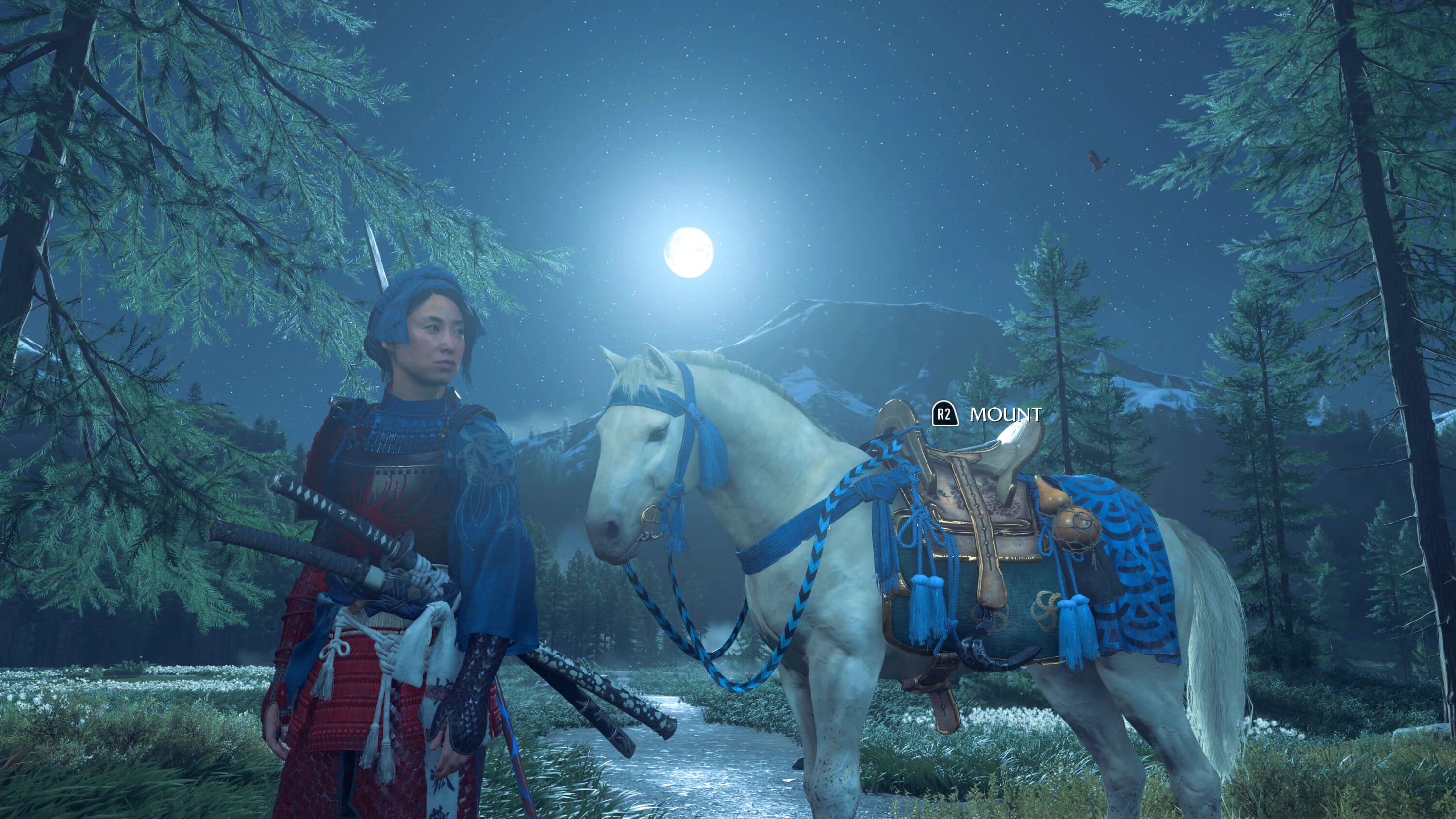
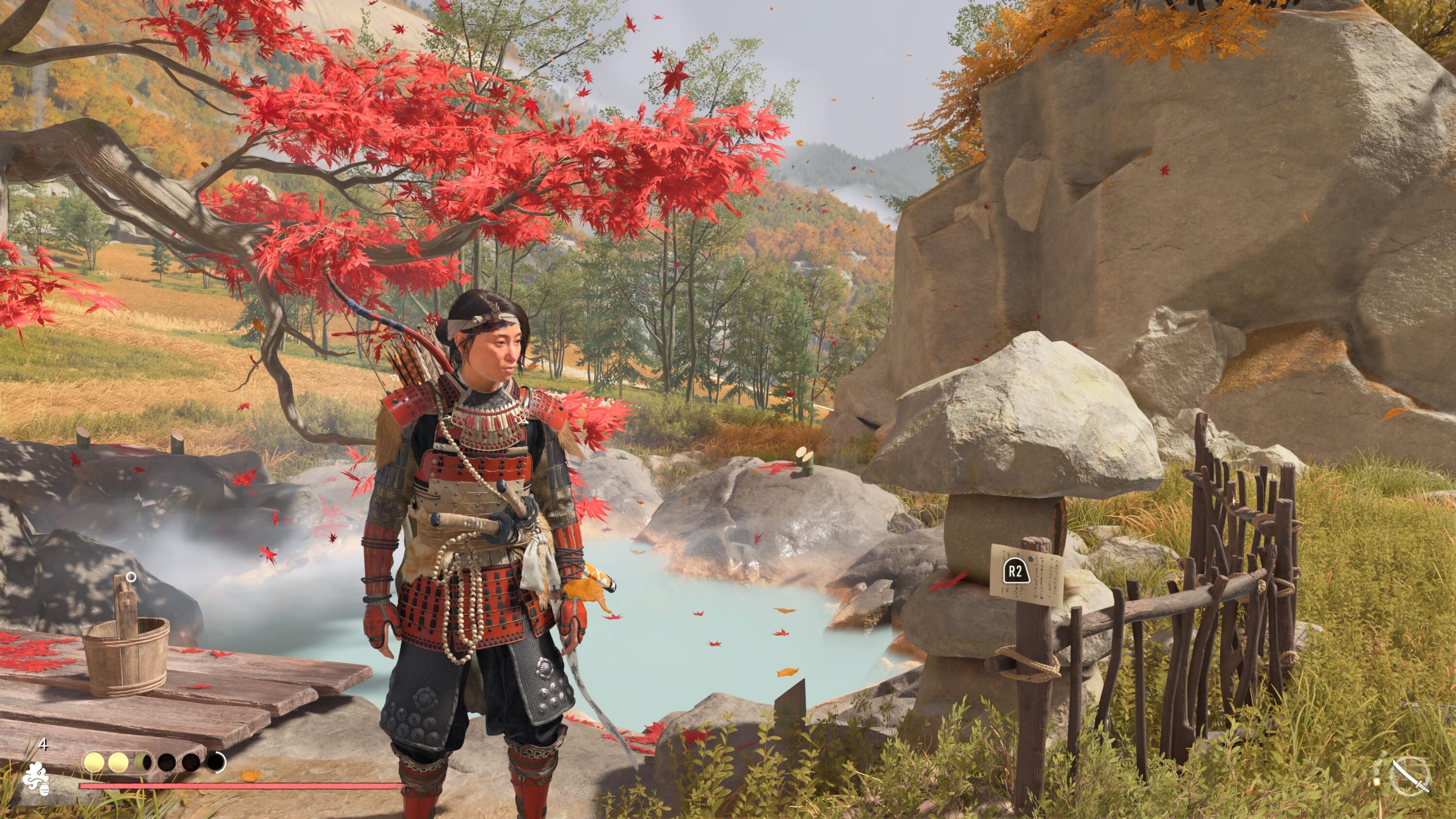
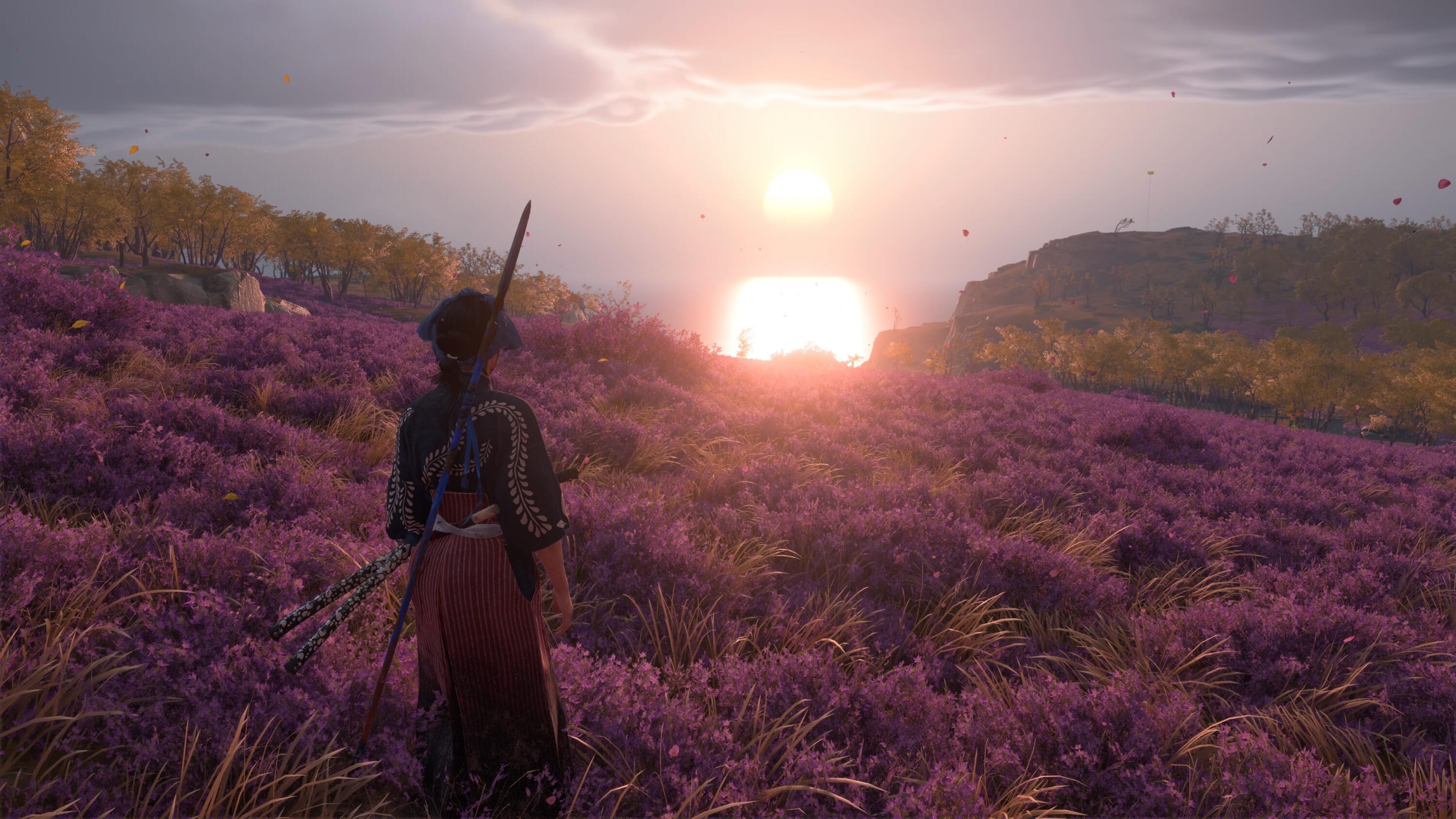
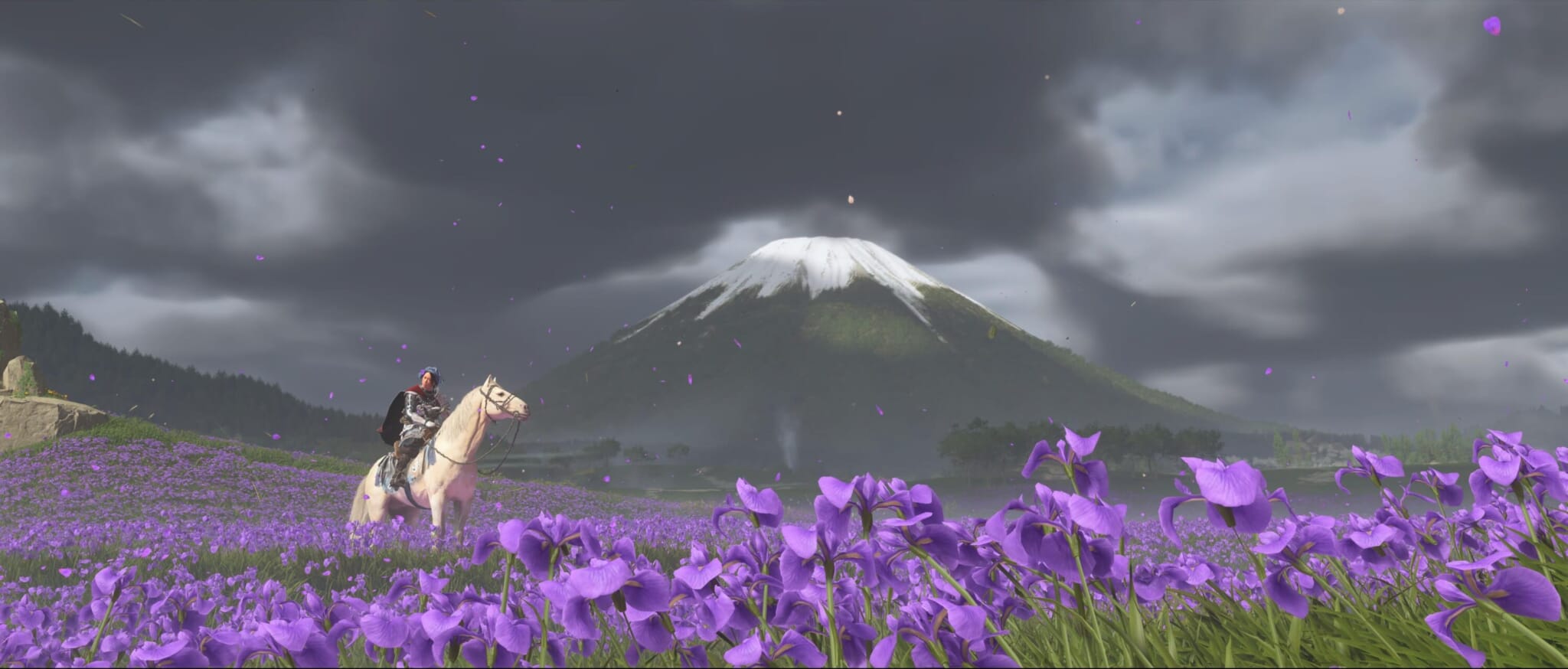
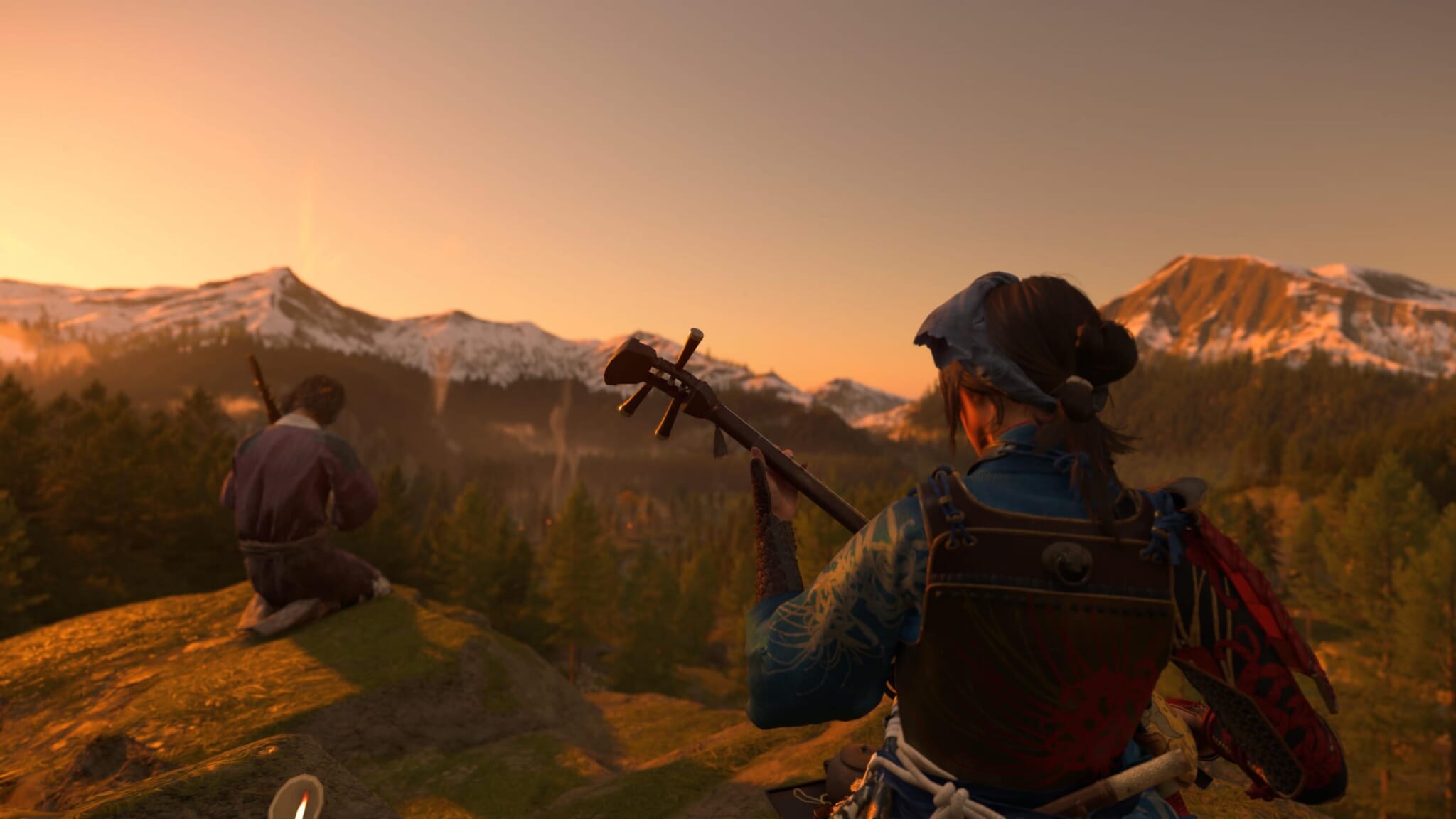
前作同様、『Ghost of Yotei』のトーンやシネマトグラフィは、伝説の監督・黒澤明による武士映画など、日本の古典的な時代劇から大きな影響を受けています。両作品ともに、画面を白黒に変更して没入感を高める「黒澤モード」を搭載。さらに本作では、渡辺信一郎(『カウボーイビバップ』『サムライチャンプルー』)や三池崇史(『十三人の刺客』)にインスパイアされたフィルターも用意されています。
今回、ソニー・インタラクティブエンタテインメントおよび『Ghost of Yotei』開発チームに、城郭から自然保護区、そしてタイトルにもなっている羊蹄山まで、制作のヒントとなったランドマークについて話を聞きました。これらは完全な再現を意図したものではありませんが、ゲームのマップや世界観を構成する重要なピースとなっています。(※一部ネタバレを含みます)
The long-awaited standalone sequel to the award-winning samurai action-adventure game Ghost of Tsushima, Ghost of Yotei (stylized as Ghost of Yōtei) is a breathtaking drama with unreal sceneries that bring its grueling but deeply emotional storyline to life.
The game, which is set in the mountains of feudal Ezo (current-day Hokkaido), follows Atsu, a wandering mercenary set on hunting down the “Yotei Six” — a group of masked outlaws, led by the ruthless main antagonist Lord Saito, who slaughtered her entire family and left her for dead when she was just a child. Atsu’s overflowing anger and resentment burns deep and has led her to fixate on eliminating the Yotei Six as her only purpose in life. Her hunt develops Atsu’s persona as an onryo, a vengeful ghost.
Like its spiritual predecessor, Ghost of Yotei’s tone and cinematography takes inspiration from classic Japanese period pieces, like samurai films by the legendary Akira Kurosawa. Both games have a “Kurosawa Mode” that converts them to a black-and-white display for a fully immersive effect. Ghost of Yotei also has filters inspired by Shinichiro Watanabe (best known for Cowboy Bebop and Samurai Champloo) and Takashi Miike (13 Assassins).
But on top of its cinematic framing, one of the most impressive elements in Ghost of Yotei’s gameplay lies its deep connection to nature. Its intricately designed environments are both a visual treat and an integral component of the game’s identity and storytelling.
I chatted with Sony Interactive Entertainment and the Ghost of Yotei game development team about the landmarks that inspired the game, from castles to nature reserves and the titular Mount Yotei. Though not intended as perfect recreations, together, these are some of the places that pieced the game’s map and overall worldbuilding. Some spoilers ahead.
Gameplay screengrab (top) and Mount Yotei (bottom) | Image edited by Aya Sato
Mount Yotei
Standing as the everpresent ethereal crown quietly overlooking Atsu’s journey of vengeance, Mount Yotei is a real stratovolcano located in Hokkaido’s Shikotsu-Toya National Park.
The Ainu, Hokkaido’s native people, make several appearances throughout the game, particularly in the Nayoro Wilds region of the map. The Ainu call Mount Yotei “Matneshiri”— the female mountain. Yotei is regarded as a sacred spot concentrated with feminine energy and resilient power. As we follow Atsu’s pursuits, Mount Yotei serves as a symbol of her as a female lone-wolf mercenary. It’s also a looming reminder of her family home, which sits below the summit. Mount Yotei is her motherland, and represents the grueling mission she’s taking on.
Gameplay screengrab
In the summertime, over 80 species of alpine plants and flowers bloom in the fields that surround Mount Yotei, also seen in the diverse flora in the game. For inspiration, the game developers visited Lake Toya, also located inside the national park — a picturesque volcanic caldera lake. On its shores, they were able to fully appreciate the grand scale of Mount Yotei.
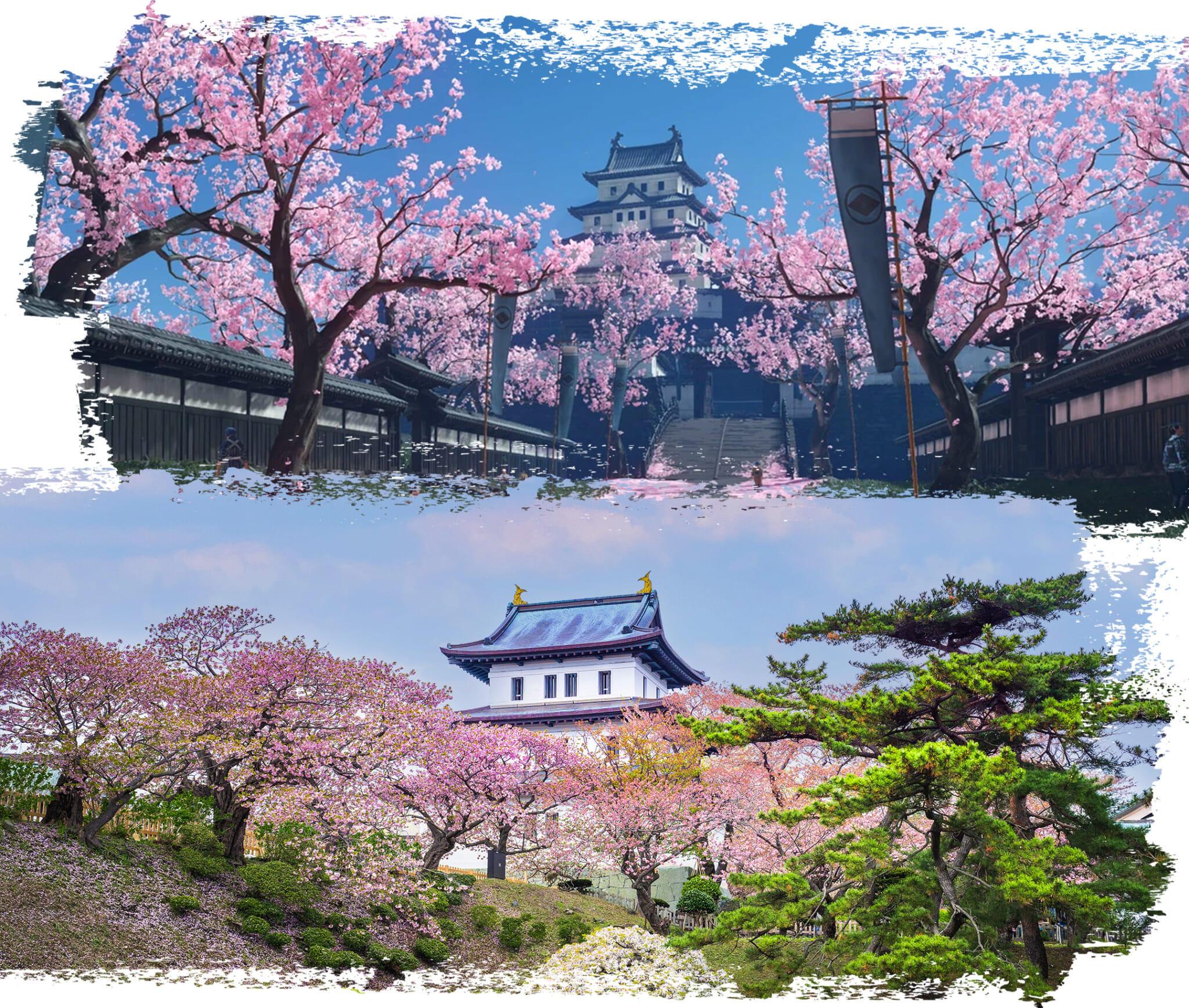
Gameplay screengrab (top) and Matsumae Castle (bottom) | Image edited by Aya Sato
Matsumae Castle
The Matsumae clan, whose domain occupied many parts of Hokkaido starting in the early 17th century, plays a significant role in the game’s storyline, serving as a contrasting presence of order against Lord Saito’s chaos and conquering tyranny. When Atsu discovers that her presumably-dead brother Jubei is actually alive, she learns that he was rescued and raised by the Matsumae samurai after the fateful night of the Yotei Six ambush.
Now serving the Matsumae as one of their loyal warriors, Jubei adds complexity to their joint childhood trauma — and serves as a point of tension when his allegiance to the clan disrupts Atsu’s revenge plans.
During the “Echoes of the Storm” mission, the clan’s central hub, Matsumae Castle, is beautifully adorned with sakura trees bursting with delicate pink petals, a divergent visual to the usually more rugged terrain.
The real-life castle still stands today. It was built in 1854 by Lord Matsumae Takahiro during the closing years of the Edo period and was rebuilt in 1961 after a fire largely destroyed its main keep. The castle remains a popular venue for cherry blossom viewing. Its encompassing park is one of Hokkaido’s most visited blossom areas, housing over 10,000 trees of more than 250 cherry blossom varieties.
Developers visited both the castle and the Matsumae clan cemetery, drawing in historical inspiration to recreate the structure as accurately as possible.
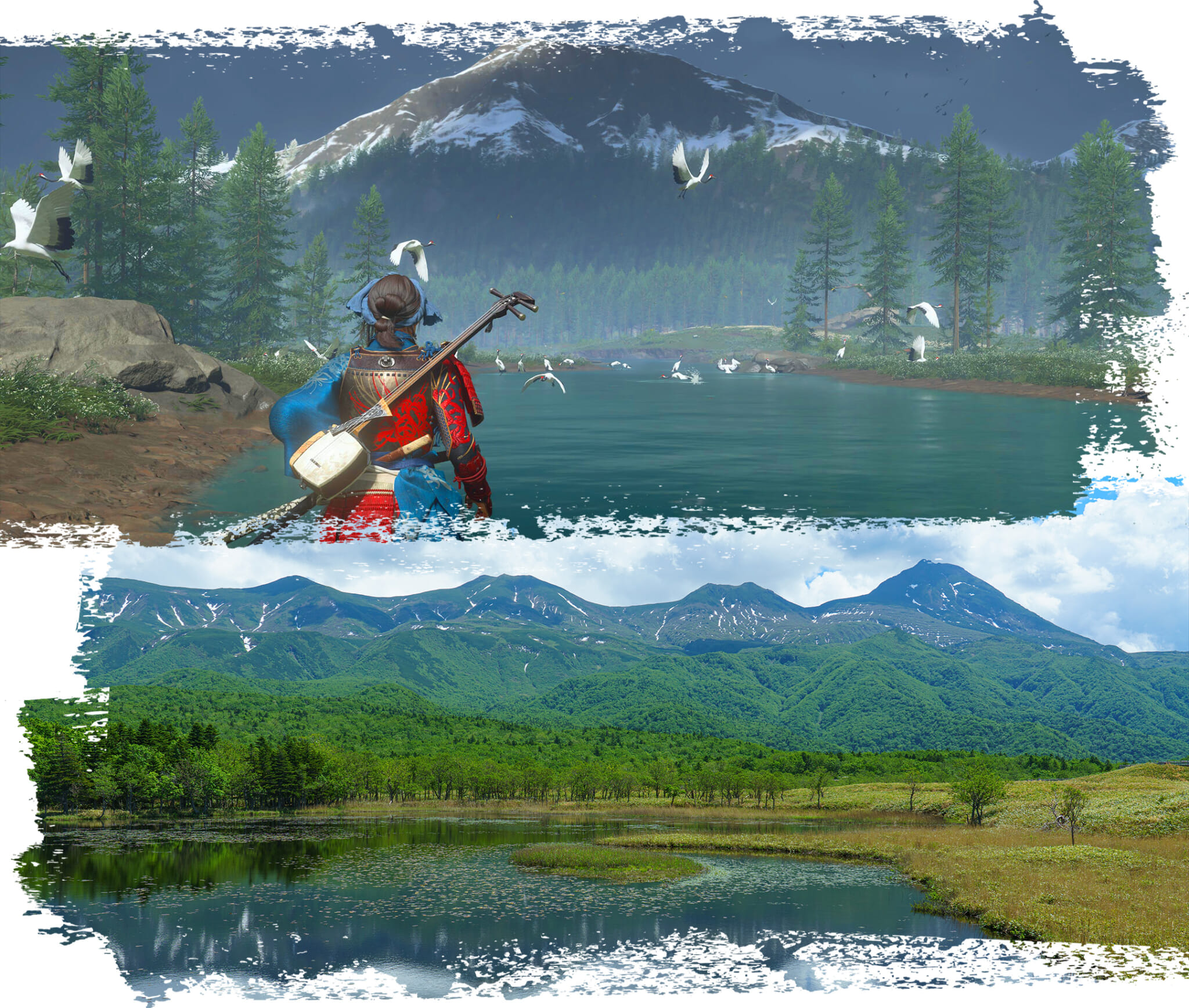
Gameplay screengrab (top) and Shiretoko National Park (bottom) | Image edited by Aya Sato
Shiretoko National Park
Coming from the Ainu phrase sir etok, meaning “the end of the Earth,” Shiretoko National Park sits on the tip of the Shirotoko Peninsula in eastern Hokkaido. Its scenic cliffsides inspired the game’s climbable mountain ranges; the area’s robust wildlife is also mirrored in the wide range of creatures that appear across the map.
The expansive 71,000 hectare park was designated as a UNESCO World Natural Heritage Site and is renowned as one of the richest integrated ecosystems in the world.
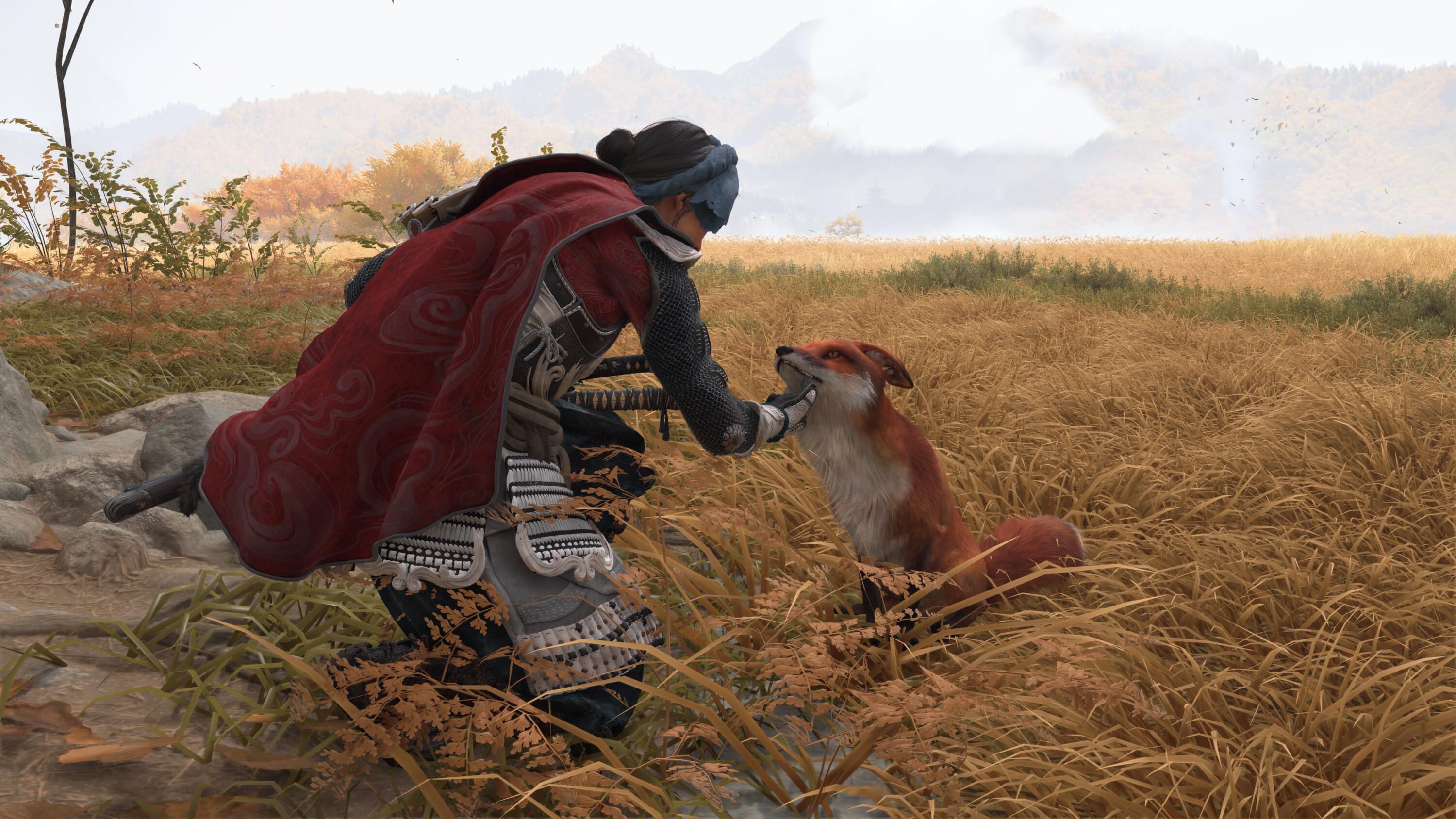
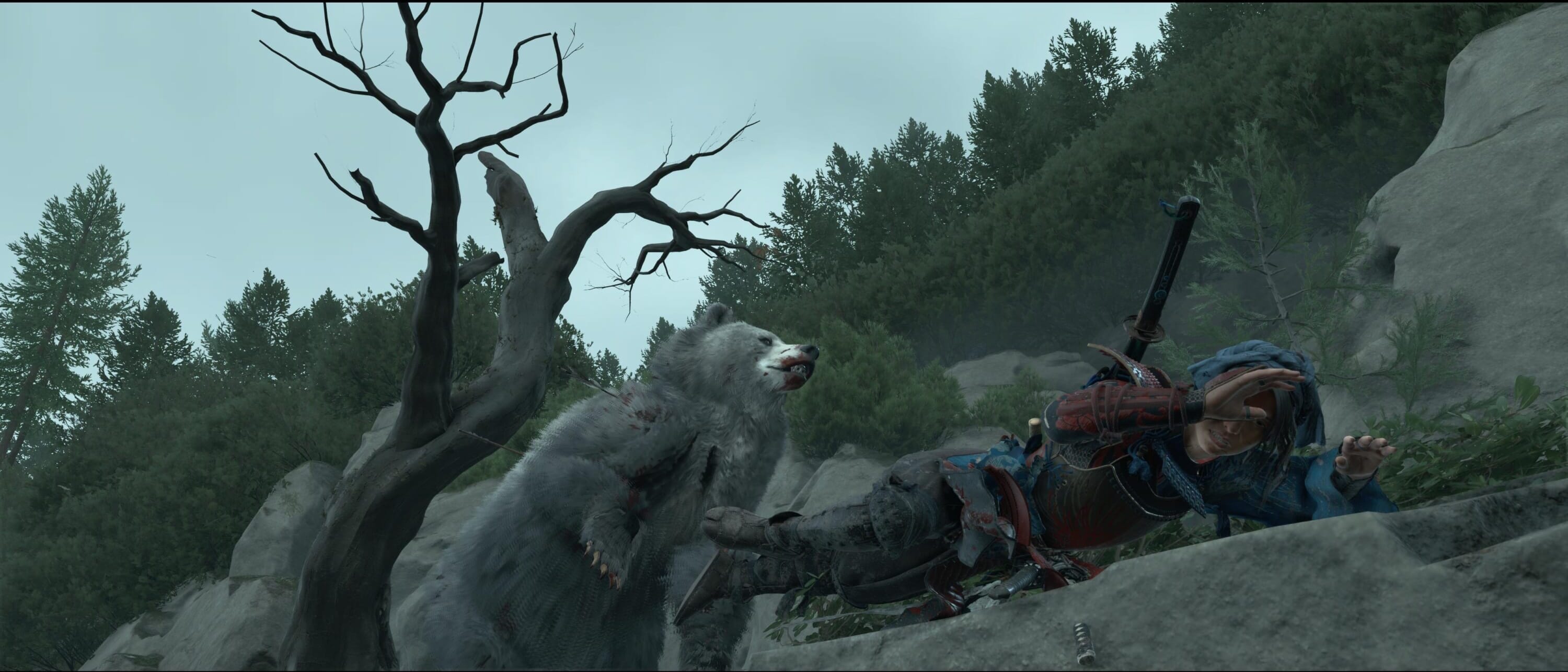
The reservation is home to a number of mammal species, including red foxes and brown bears, which are featured in Ghost of Yotei. An estimated 400 Ezo-Higuma brown bears call the park home, making Shiretoko the site of the world’s densest brown bear population. As bears compete over food sources, they will sometimes stalk unsuspecting humans and become brutal threats; in the game, accordingly, they can be a very dangerous presence.
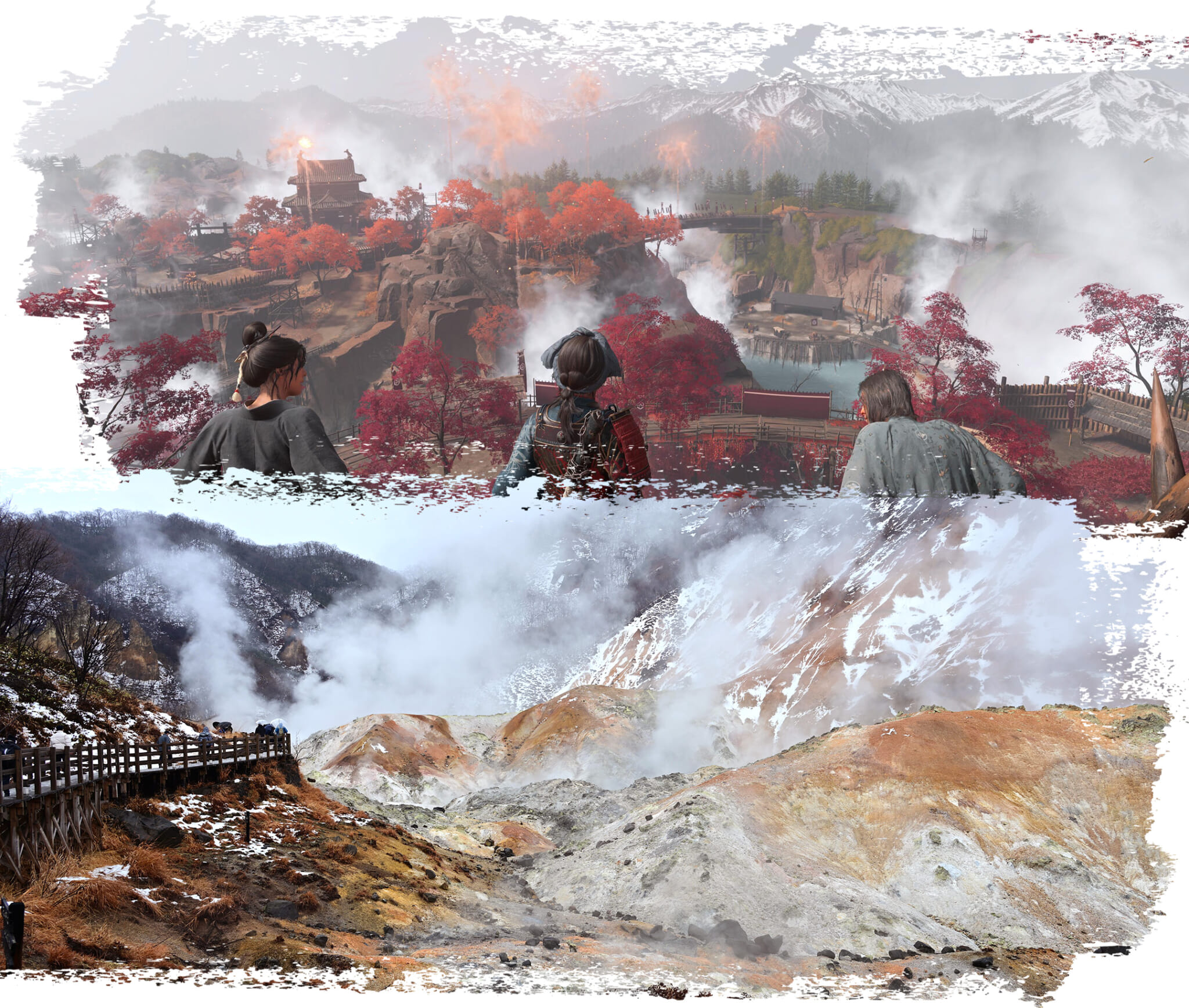
Gameplay screengrab (top) and Noboribetsu Jigokudani Valley (bottom) | Image edited by Aya Sato
Noboribetsu Jigokudani Valley
Also known as “Hell Valley,” Jigokudani Valley in southwestern Hokkaido inspired the rugged terrain and misty atmosphere enveloping Koga Fortress during the “Final Hunt of the Onryo” chapter.
True to its name, Jigokudani retains a hellish power. As the regional tourism association describes, the springs’ ferocity is “proof that the Earth is alive.” The valley floor releases over 10,000 tons of mineral-rich water each day, with boiling springs just beneath the yellow-gray sulfuric mounds. Volcanic gasses emit sharp hisses and white steam ejects furiously — but the surrounding landscape is picturesque, a dynamic that complements the game’s focus on life’s balance between intense serenity and cruelty.
Local folklore of oni demons directly influenced the game’s mythology and design. Legend states that evil demons once inhabited the area and tormented people. As punishment for their wickedness, the Ezo gods forced them to work as guards of the medicinal baths. In the summer, oni-hanabi (demon fireworks) performers wearing oni masks dance and bang on drums to collect the misfortunes that have befallen guests throughout the year. These curses are then burned and shot up as 8-meter-high fireworks.
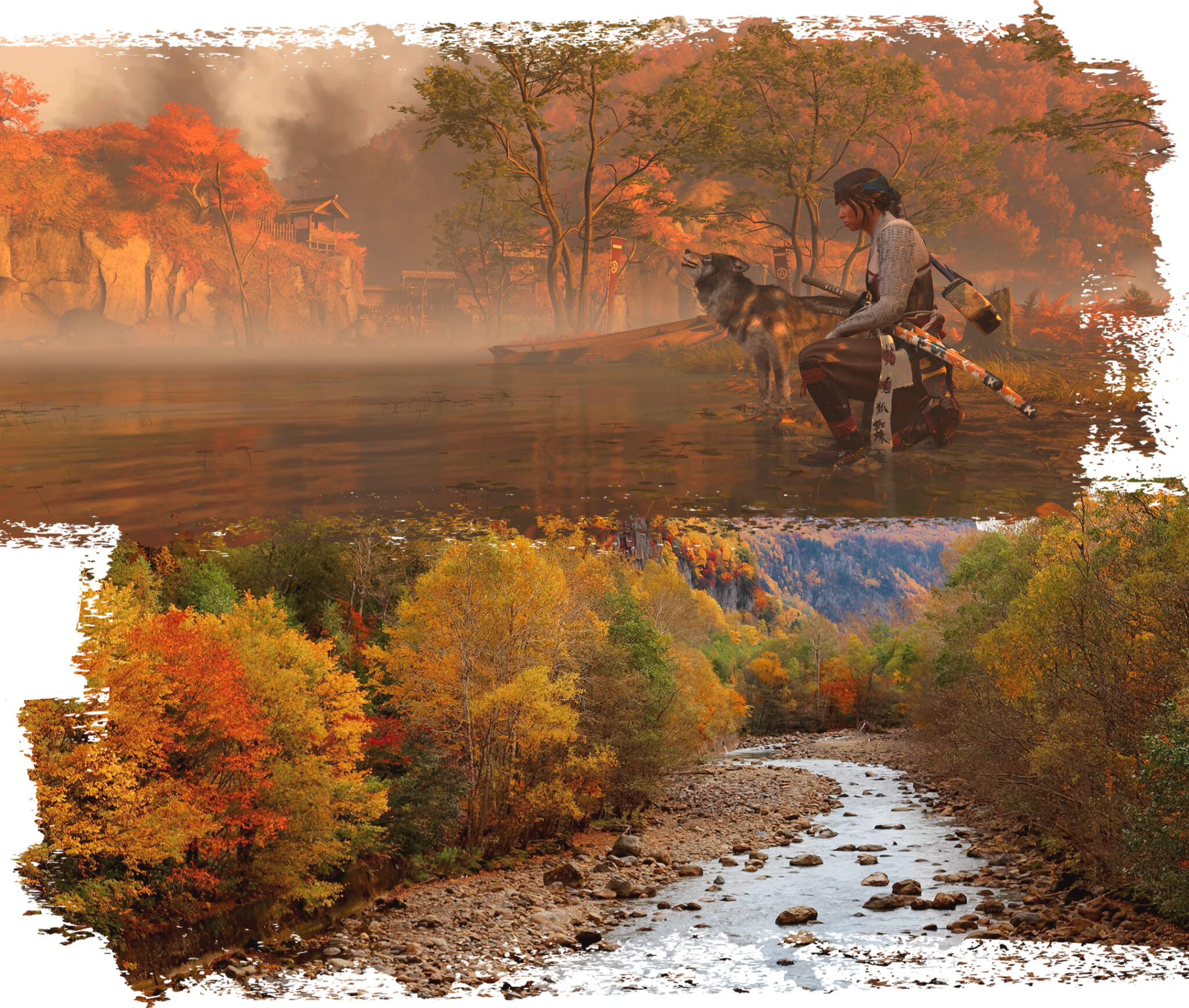
Gameplay screengrab (top) and Ishikari River (bottom) | Image edited by Aya Sato
Ishikari Plain
The Ishikari Plain in western Hokkaido is another location with a direct feature in Ghost of Yotei, as is the pristine Ishikari River, the third-longest river in Japan. The Ishikari Plain’s name also derives from Ainu culture, with ishikaribetsu translating to “greatly meandering river,” describing the long gentle flow of water that Atsu travels through.
The plain makes an appearance as one of the main settings during Atsu’s hunt for The Oni, one of her revenge targets.
Gameplay screengrab (top) and Studio Sedic (bottom) | Image edited by Aya Sato
Studio Sedic Shonai Open Set
Though located outside of Hokkaido, Studio Sedic in Yamagata helped to inspire Ghost of Yotei’s set design.
Studio Sedic is a film set where numerous historical movies and dramas have been shot, including the Academy Award-winning film Departures, and it’s open for the public to explore. The film set sprawls over a vast 88 hectares, making it the largest studio in Japan; it’s designed to resemble a traditional farming village from around the Sengoku and incoming Edo eras, precisely the transitional period that Ghost of Yotei takes place in.
The 6.5-meter high castle gate, complete with a cannon-stocked watchtower, and the traditional thatched-roof houses are all details that helped developers recreate a historical community.
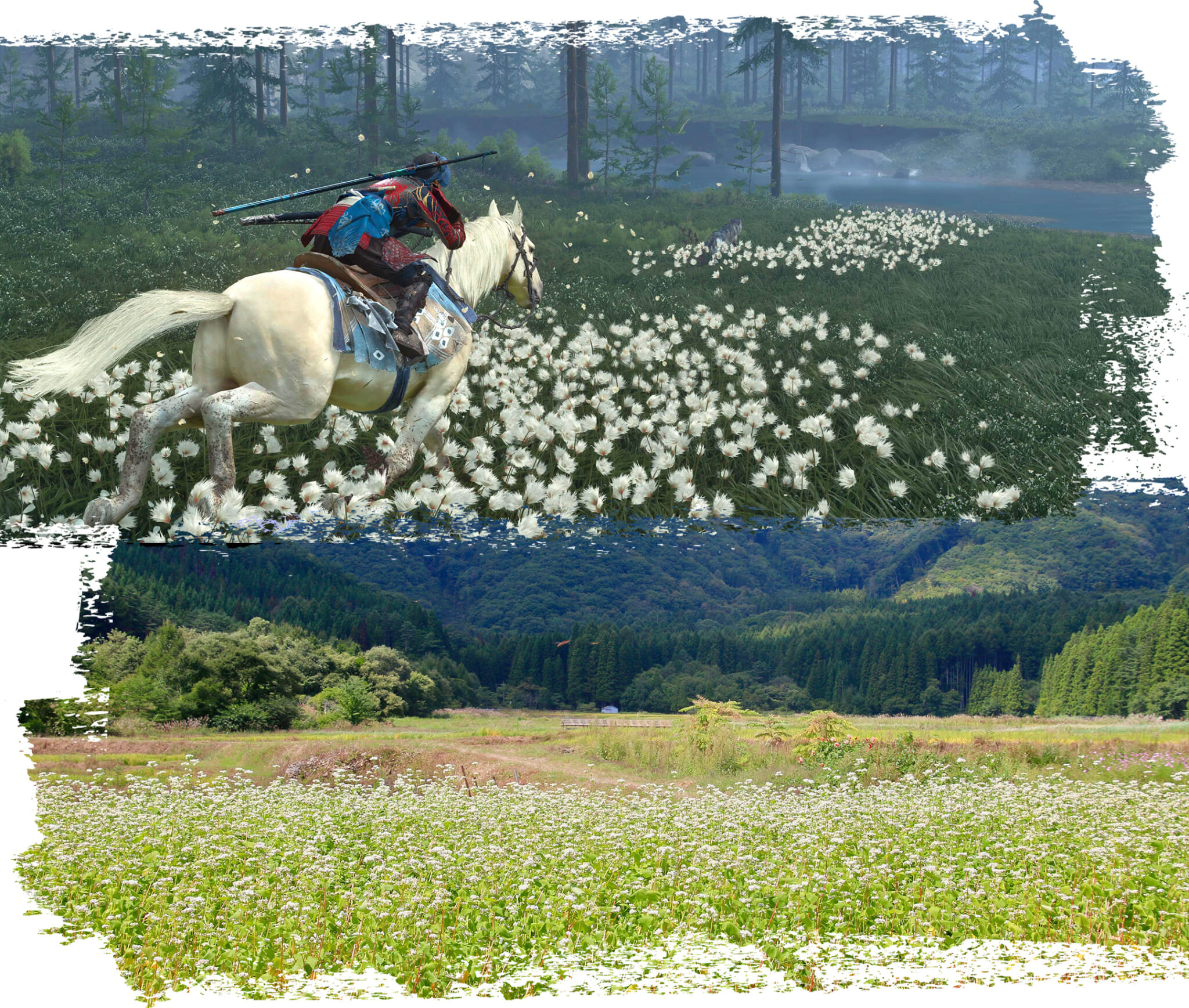
Gameplay screengrab (top) and Ouchi-Juku (bottom) | Image edited by Aya Sato
Ouchi-Juku
Fukushima’s Ouchi-juku — another location outside of Hokkaido — is a reference point that took the Ghost of Yoteiteam on a journey to the past. The area, once a bustling post town, is famous for its carefully preserved thatched-roof houses crafted with grass, straw and bamboo.
Ouchi-juku now registered as a “Preservation District for Groups of Historic Buildings” by the Japanese government, displaying a slice of daily life in the Edo era, complete with details like cooking hearths that make the space feel authentically lived in. Village houses, eateries and shrines present the northern-style architecture that formed the visual identity of the time period in the game.
Ouchi-juku’s specialty buckwheat and pampas grass also make a prominent appearance in Ghost of Yotei through the fields Atsu traverses on horseback.
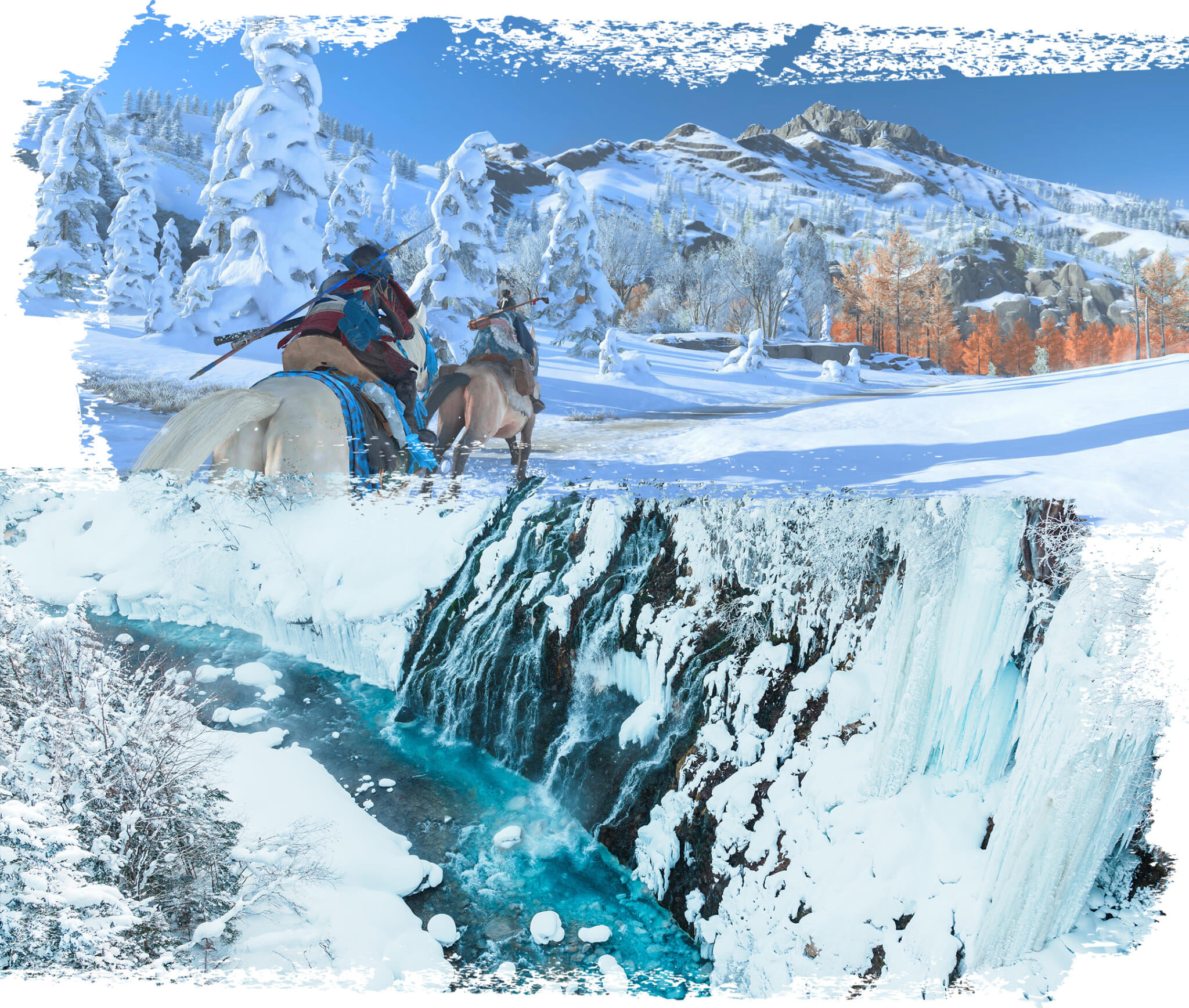
Gameplay screengrab (top) and Shirogane Blue Pond (bottom) | Image edited by Aya Sato
Shirogane Blue Pond and Risshaku-ji Temple
As Atsu tracks the Kitsune, she traverses the frigid Teshio Ridge, where she encounters piercing blizzards and the Nine Tails shinobi assassins. The beautiful but ferocious snowy landscape parallels the alliances and violence that the area sparks in the storyline.
Central Hokkaido’s Biei Town, with its ethereal snowscapes, brought part of the inspiration for Teshio Ridge. Biei Town features hilly terrain and vast farmlands that become blanketed in silvery white during the wintertime — a sight that makes the town a treasured winter destination for snowshoeing, snowmobiling and other icy activities. Biei Town is especially famous for the Shirogane Blue Pond, a pond with surreal cobalt-blue water that creates a dreamlike scene surrounded by glaciers.
The pond was formed by accident during the construction of a dam. Mineral-rich groundwater from Shirahige Falls mixes with the Biei River, and the resulting mix of microscopic particles create the striking blue hue.
Yamagata Prefecture’s Risshaku-ji Temple, also known as Yamadera, was another location that contributed to the design of the Nine Tails den. The ascent up the mountain temple has over 1,000 stone steps that overlook a serene snow-covered valley and cedar forest.
Gameplay screengrab
As an honorable mention, the team also made a stop at Tochigi Prefecture’s Nikko Toshogu Shrine, the lavishly-decorated shrine that is set around the mausoleum of the shogun Tokugawa Ieyasu. The Tokugawa shogunate ruled over Japan for over 250 years until the Meiji restoration.
At the shrine, the Ghost of Yotei team participated in a gokito ceremony, a formal Shinto prayer that wards off evil and invites good fortune, to wish for the success of the project and receive the shogun’s blessing.
Ghost of Yotei is available to play exclusively on PlayStation®5. The newly released multiplayer expansion that reimagines the Yotei Six as supernatural yokai, titled Ghost of Yotei Legends, is now available as a co-op menu option. Ghost of Yotei is rated M for Mature (17+).