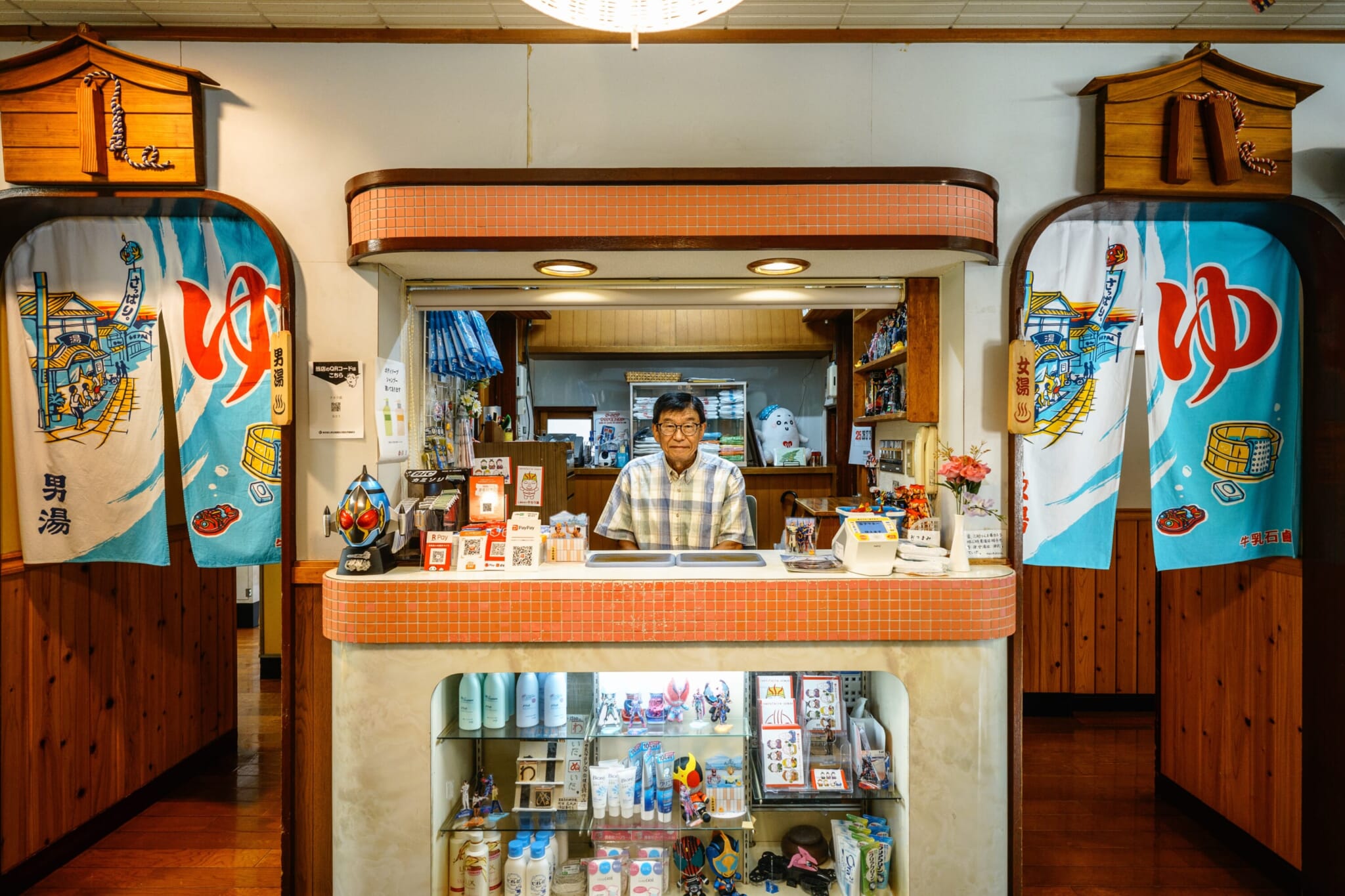
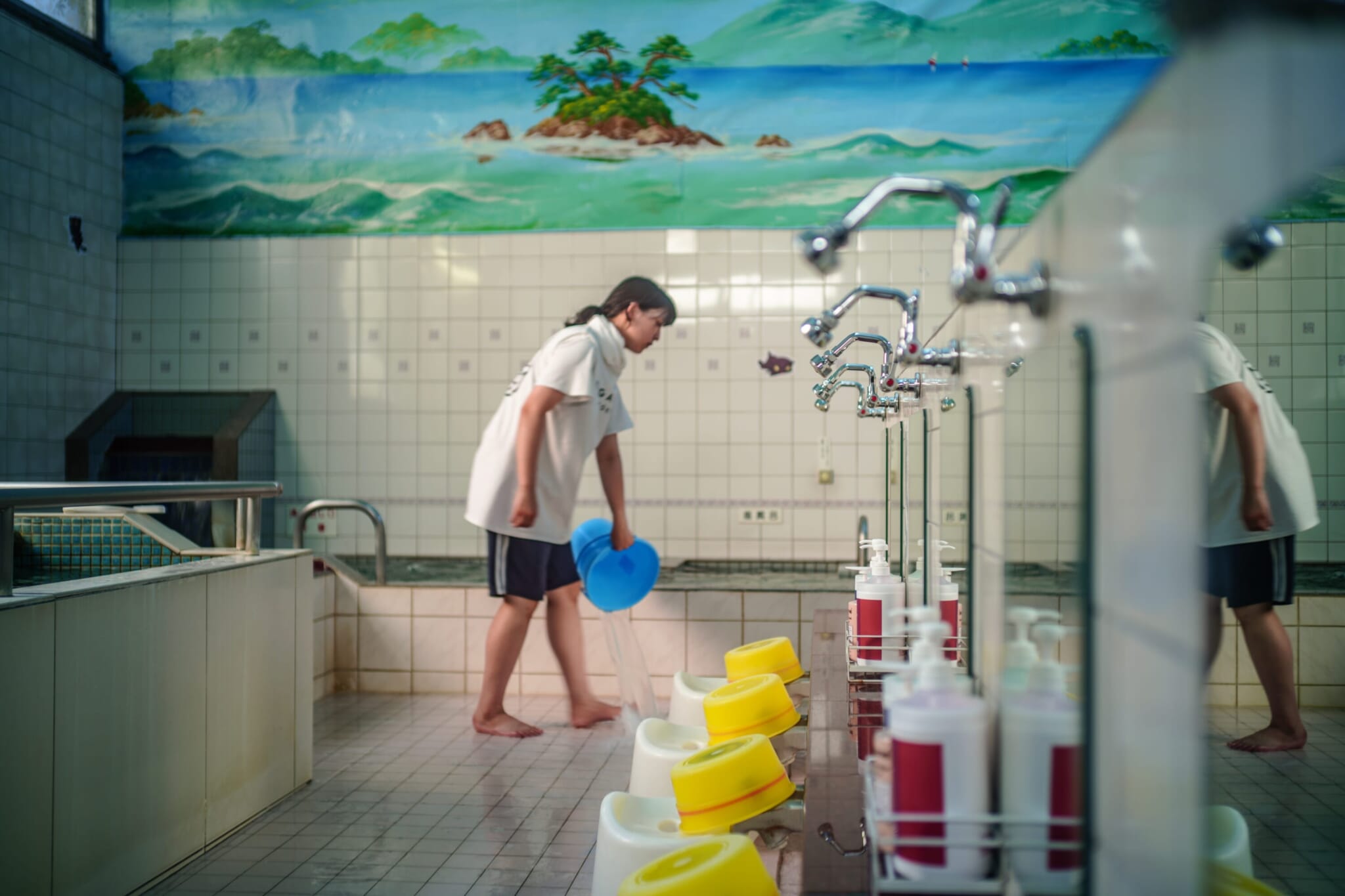
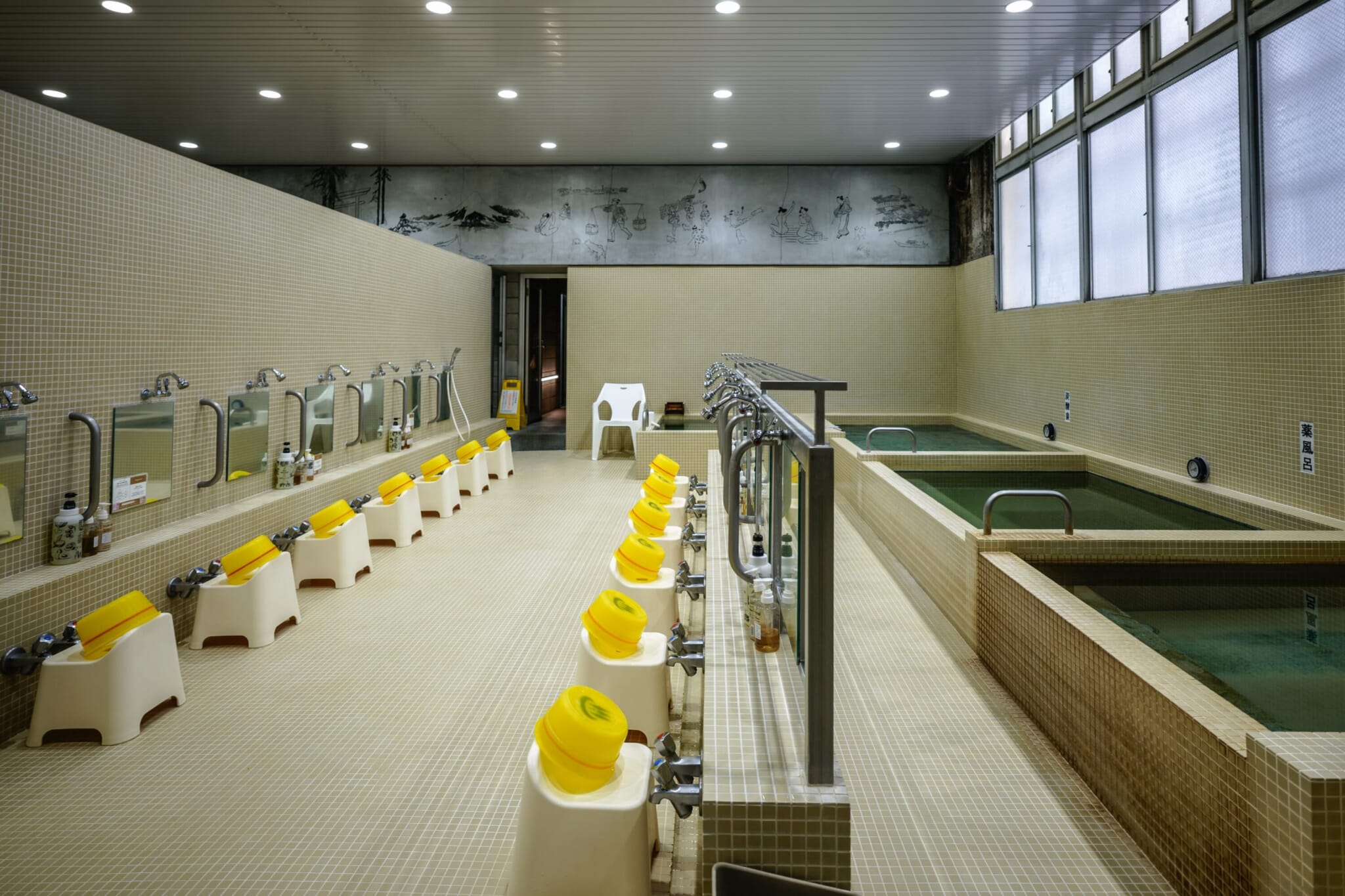
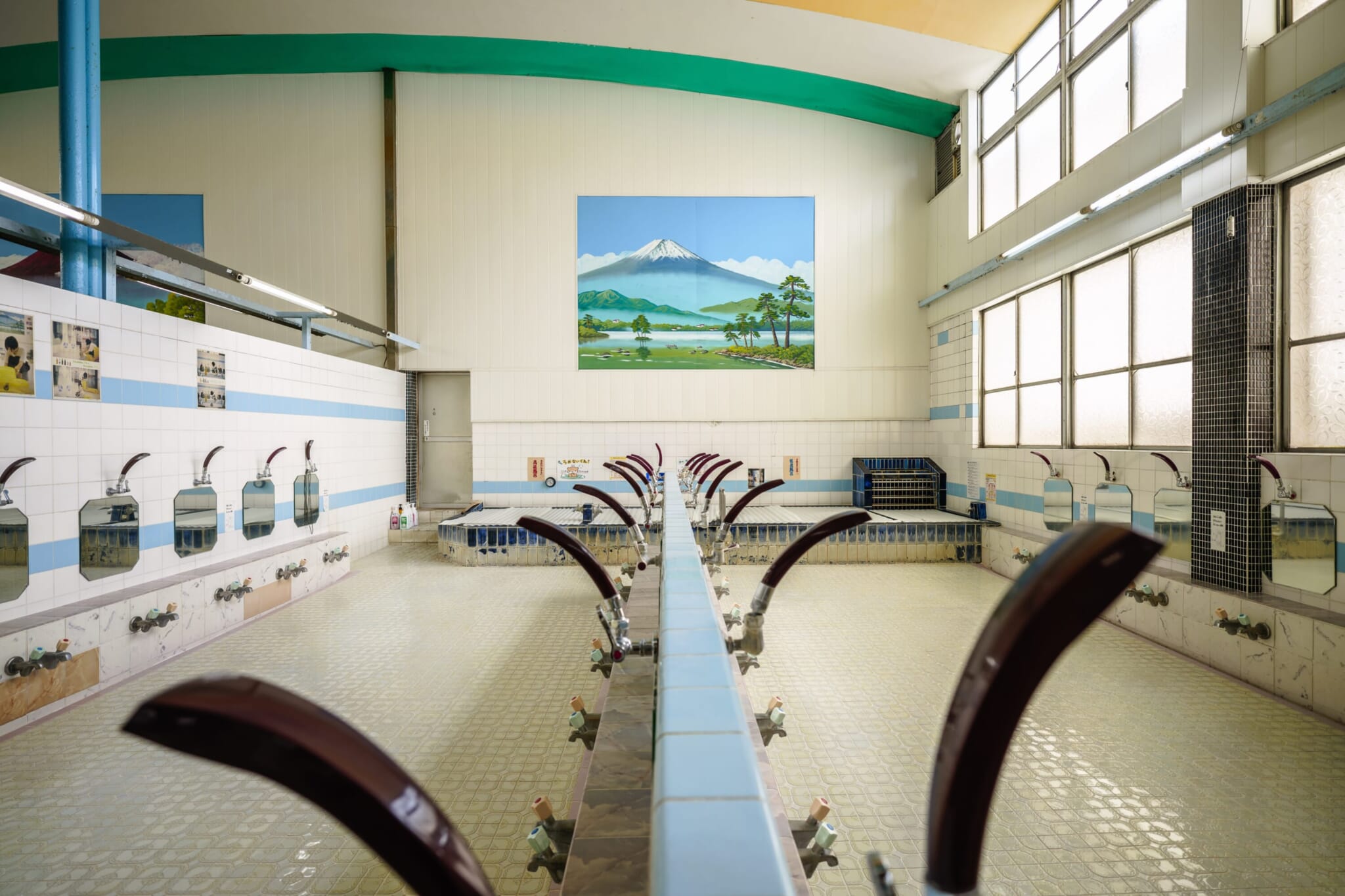
It’s the afternoon in Kyojima. Outside a small corrugated iron shutter stand a dozen people, mostly elderly standing around waiting. They carry small plastic baskets with shampoo and conditioner, and have towels wrapped around their shoulders. At 3 o’clock on the dot, the shutter opens and they bustle into the entrance of their local bathhouse, Denkiyu. The chamber of the sento is flooded with light, the ceiling, painted in pastel blue and orange stripes, is incredibly high, allowing the moisture from the bath to vaporize. Soaking in the hot waters allows the body to completely relax. The patrons slip deeper into the water, immersing themselves, letting out a sigh.
Sento Sensibilities
The culture of sento developed in the Edo era, where sento were initially meant as places to wash, as individual homes didn’t have their own bathrooms. They are still found in mostly residential urban areas, and serve as places to wash and soak despite 98% of residences in Japan being fitted with bathrooms now. They have taken a new role as a way to relax, to rejuvenate the spirit and luxuriate in the retro vibe, unique architecture and design.
Sento also provide an egalitarian, unpretentious space where, for around ¥500, one can enjoy a community where anyone, regardless of status and age, can communicate and engage in small talk. While the joys of sento — bathing, chatting with random strangers and relaxing with a coffee milk afterwards — are familiar pleasures and rituals for those in the know, sento are an increasingly rare sight in urban metropolises across Japan. In Tokyo, around 100 sento closed within six years — an alarming rate considering there are fewer than 500 left.
The Historic Bathhouses of Edo
The first sento is said to have been established at old Edo’s Zenigame Bridge in 1591. Around that time, the population in the capital exploded to over a million, with an influx of workers moving to the city from across Japan. Alongside the growth was urban development and infrastructure to support the population. Most commoners lived in wooden houses, which were vulnerable to fires. Woodblock prints of the Edo era often feature aspects of firefighting culture as there was the perpetual risk of a blaze consuming entire villages.
As such, townsfolk living in downtown Tokyo were prohibited from having their own firewood heated baths, so sento were established to cater to these people and hence became part of the daily life of Edoites. The peak of sento usage, however, came much later in the post-war period: By 1968, there were over 18,000 sento in Japan.
Takarayu was established in 1927 and survived World War II. It remains one of the most popular historic bathhouses in the city, affectionately dubbed the King of Sento for its impressive structure and vast gardens. It sports a temple-like form called miyazukuri, with a karahafu curved gable, giving it a transcendent atmosphere and separating it from the ordinariness of daily life. Owner Koichi Matsumoto says, “The building is all wooden, but I think that is why we survived for so long. There were many lumberyards in this area of downtown and a plethora of woodworking factories, companies to do with wood products such as pencils. They were using the Sumida and the Arakawa waterways to transport goods. It was really difficult to get materials to burn so quite often sento could be found near places where you could get combustibles. All the lumberyards have gone now and we use gas now to heat the water.
“There were 36 sento in this area. Although only six of these now remain, at its peak in 1971, in the whole of Adachi ward, there were 154 baths. But now there are only 20 or so. The last 10 years, it became a place for old people; primary schools closed, too. However, we survived because in the place of these schools, universities opened campuses. In Adachi there were no universities and now there are six. It suddenly became a student town, so we get a lot of youths. For instance, Teikyo University of Science students come for a soak after judo matches.
“Customers come here every day — it is part of their lifestyle. For elderly who live on their own, it is better than being trapped in their homes. Actually 7,000 to 8,000 die at home in their baths — more than in car accidents — and no one notices for days. Because the bath here is large, it doesn’t get cold like the bath at home where the body temperature lowers the bath water temperature. You can relax in the garden with a beer or coffee milk.”
Hipster Bathers Lead the Revival
It’s not just granddads and grannies going for a wash, and sento is experiencing a bit of a moment right now. Sento branded goods are flourishing, as are events and sento-themed art shows. Kai Tanaka runs Osentou magazine on Instagram. The account boasts over 10,000 followers and is one of many dedicated to Japan’s bathhouse culture. Tanaka says his followers are 55% female and 45% male and overwhelmingly made up of young people in their 20s.
“It is a bit trendy to go to them. Young people perceive it as something fresh, not nostalgic. It reminds us of our grandma’s house but it isn’t something we feel an immediate familiarity with. I think they are artistic, beautiful and otherworldly; it is something like a new culture. It isn’t entirely mainstream kids that are into this; it is more like the types that like vinyl and coffee at Doutor. It is also aligned with sauna fandom, as that is really big at the moment,” he says.
Tanaka suggests that one of the large sparks that lit the sento fire among the younger crowd is Kosugiyu in Koenji. He says, “It is really famous among young people. It is really accessible, cute and they have themes like lemon milk baths that draw young women.”
Tanaka observes that the young people around him want to experience “healing” and the term “iyasareru” (to be comforted or healed) is a current trend. “There is also a tendency to bottle things up inside. Everyone is busy and there are a lot of lonely people. Also, within their personal lives and also at work, everything is digital, digital, digital,” he explains.
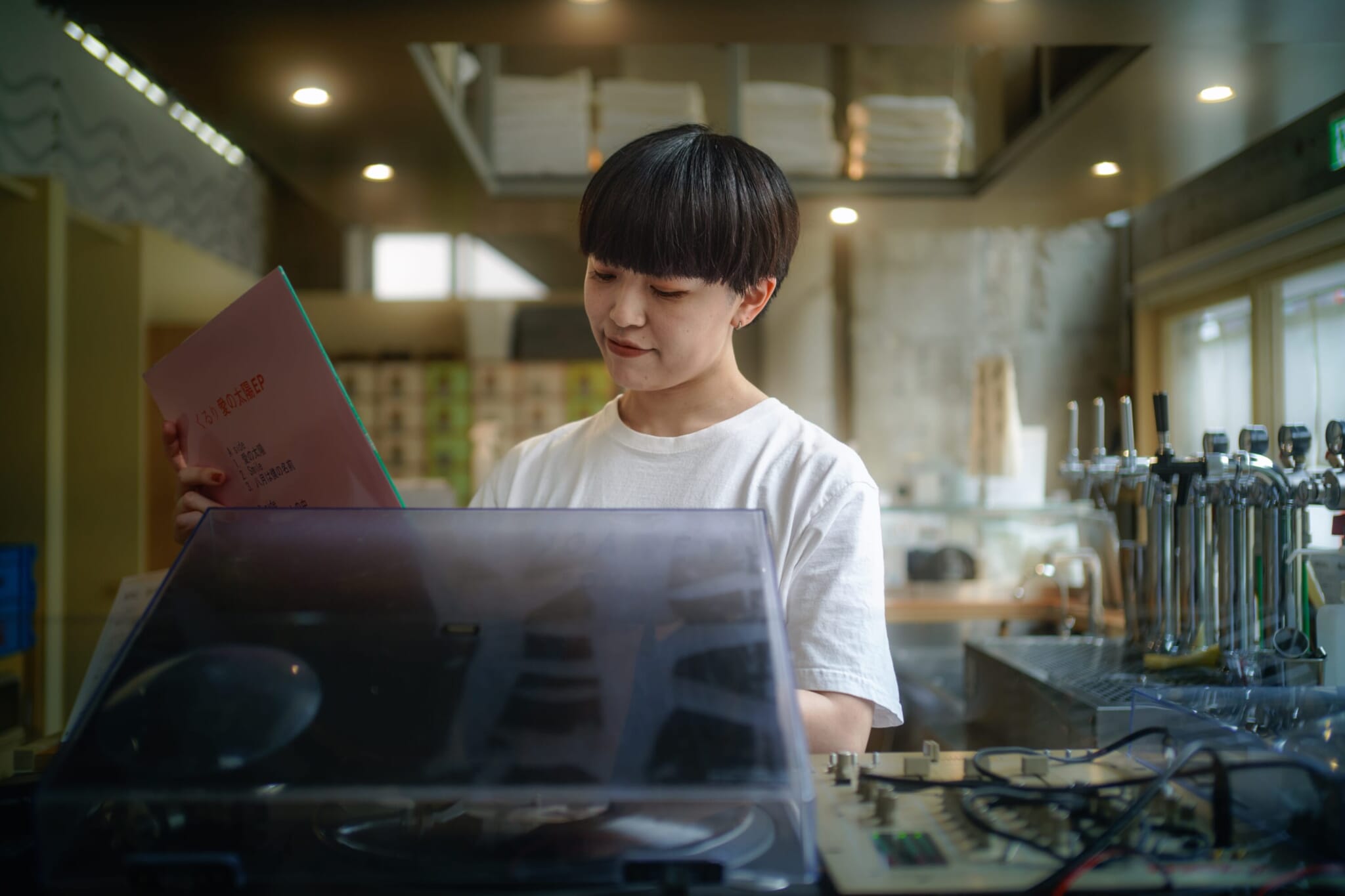
Daikokuyu and Koganeyu are two incredibly hip sento close to Kinshicho that are popular among young people. Open all night, Daikokuyu is a classic sento with Tokyo Skytree views and large open-air baths. Koganeyu, designed by Jo Nagasaka — also the architect for numerous Blue Bottle Coffee cafés — is one of the chicest sento in Tokyo, with a DJ booth and a space age-looking sauna. The sento often collaborates with brands like Converse.
Koganeyu owner Takuya Shinbo says, “Sento reset the sympathetic nervous system. I think contemporary people are too tired. They are always thinking too much. I think rather than us trying to transmit the sento boom and tell people what is good about them, it is something people should feel for themselves with their bodies.”
Koganeyu’s design incorporates contemporary elements that merge with its traditional structure.
Still Struggling to Survive
Running a sento is, basically, a lot of hard work. Shinbo explains that they clean until 3am and then again at 10am. “We work two times more than regular people, and we have to continue that for decades. We have staff, but most places can’t afford them. You need perseverance to do it.”
Even a popular sento like Denkiyu, the building of which is owned by manager Katsuhito Okubo’s grandmother, struggles. Okubo admits, “If I had to pay rent, it would be impossible.” Under Okubo’s supervision, Denkiyu went from 90 customers a day to 250, and on average 3,000 per month. One reason is that Okubo himself facilitates a sense of community. He hosts events and exhibitions — lounging around the sento rest area is like a communal living room for the creators of Kyojima.However, the reality of owning a sento is that it costs around ¥700,000 a month to heat it. Although he receives subsidies, making it closer to ¥400,000, there are still staff fees, utilities, renovations, painting and other costs to consider.
Sento Dashi is a group of architects, urbanists and a ceramicist who made a dashi float from parts amassed from defunct sento. They go around Tokyo as part art installation, part transmission vehicle. They have the doleful task of archiving sento that have closed in their neighborhood of Bunkyo ward. Urban designer and architect Masaya Sammonji says, “There were 12 sento here and now there are only four. Even within Tokyo, the decrease is large. Over the last 11 years, we’ve surveyed them before they disappeared: We take photos and architectural scans and publish them in a magazine. We also receive architectural parts like the tiles and lockers. There was no point just amassing these things, so we made a mobile sento that we use to garner attention to sento culture.We want people to know about them.”
Architect Haruka Kuryu explains that Bunkyo ward is particularly challenging since it’s a high-end residential area with a demand for apartments, and it is much more lucrative to develop than run a bathhouse. However, she sees the value of a sento as many times more substantial than commerce alone.
Denkiyu is a much-loved local institution in Kyojima.
Sharing Public Spaces
Ultimately, sento occupy an unusual semi-public place, which is unlike a café or a park. On top of that, let’s not forget people are naked: This means that they are removed from the usual signifiers of social prestige such as fashion, makeup and jewelry, making sento a place free of status. Sento Dashi member and ceramicist Yuki Murata says that sento are at the liminal space between “public” and “private,” but ultimately it is the community and others that make sento an important institution for a locality.
“While there might be a tendency for younger people to go for individualistic reasons, too,because they are fun and refreshing. As a gathering space, a sento is the ultimate place for the community,” Kuryu explains. “There aren’t that many places where people of different generations gather. If you are living in apartments, you don’t really know who is living next door and you have no connection with the locality. If you go to the sento, regular grannies talk to you and you see the faces of the people you live with.
“Old school sento are about coexisting with others, knowing others, sharing space — it is really important to emphasize ‘others.’ If there isn’t a place like this, life really is about oneself only.”